
Key Findings
China’s CDP Market Overview in 2023–2025
In the second half of 2025, China's CDP market reached USD 134 million, a year-over-year increase of 18.5%. Looking at market performance in recent years, the growth rate of China's CDP market has shown periodic volatility, but the overall long-term growth trend remains evident. With the continuous empowerment and deep penetration of AI technology, China's CDP market will keep undergoing iterative development. The core market dynamics are as follows:
- Initial growth driver — digital transformation as the foundation: China's CDP market first gained momentum from enterprise-wide digital transformation, especially marketing digitalization and the unification of customer data across the end-to-end customer journey.
- Industry transformation catalyst — commercial implementation of generative AI and agents: Driven by the commercial deployment of AI, generative AI, and agents, enterprises’ requirements for real-time decision-making and intelligent operations continue to grow.
- Product positioning evolution — from a data tool to an intelligent operations platform: CDP has evolved beyond its role as "basic data system". It is becoming an "intelligent customer operations platform" used to support AI-driven automated marketing, customer insights, personalized recommendations, intelligent customer service, predictive analytics, and other capabilities.
- Business value upgrade — a shift in enterprise procurement logic: This makes CDP's budget logic clearer and amplifies its business value, transforming it from a data governance tool to a key platform for business growth.
Drivers of China’s CDP Market Development
Enterprise digital transformation remains the foundational driver. AI and generative AI enhance CDP's business value, while agentic AI further propels CDP into the role of an intelligent customer action hub:
Traditional Deployment for Revenue Volume, SaaS Deployment for Growth Elasticity
Based on the market structure from 2023 to 2025, traditional deployment still accounts for a substantial share of revenue. It shows distinct advantages in scenarios that require high average order value, high compliance, and complex integration. SaaS deployment delivers stronger incremental contribution, driven by the proliferation of AI marketing applications, enterprises' pursuit of cost reduction and efficiency gains, and increased digital procurement by mid-sized customers.
Traditional deployment mode — stable growth backed by large enterprises and high-compliance industries
Traditional deployment remains a key foundation of China's CDP market, driven primarily by finance, automotive, the public sector, healthcare, and large-scale enterprise customers. These customers have high requirements for data security, permission management, private deployment, system integration, and audit trails, and tend to adopt on-premises or dedicated cloud deployment.
In 2025, the growth of traditional deployment was largely attributed to the expansion of the existing platform, data governance upgrades, group-level customer data integration, and compliance capability development. It is characterized by larger project values, longer delivery cycles, and higher levels of customization, but new customer expansion remains relatively cautious, with more steady growth.
SaaS deployment mode — growth boosted by lightweight procurement from mid-to-large enterprises and AI applications
The SaaS deployment mode is a key driver for CDP market growth in 2025, especially with robust demand in industries with high marketing agility requirements such as retail, e-commerce, consumer goods, culture and tourism, and local life services.
As capabilities such as AI audience segmentation, intelligent recommendation, content generation, automated marketing, and customer journey orchestration mature, SaaS-based CDP facilitates modular subscriptions and continuous repurchases. Their growth is characterized by a lower average order value, yet they offer broader market reach, faster product iteration, and higher revenue sustainability.
China’s CDP Market Competitive Landscape Analysis
In H2 2025, competition in China's CDP market has entered a stage of “AI-native capability reshaping the competitive landscape”.
Leveraging Magic AI, Customer AI, and the WeChat ecosystem, Tencent has secured a leading position of high market share and robust growth:
Tencent Marketing Cloud: Strengthening its leading edge with Magic AI and Customer AI
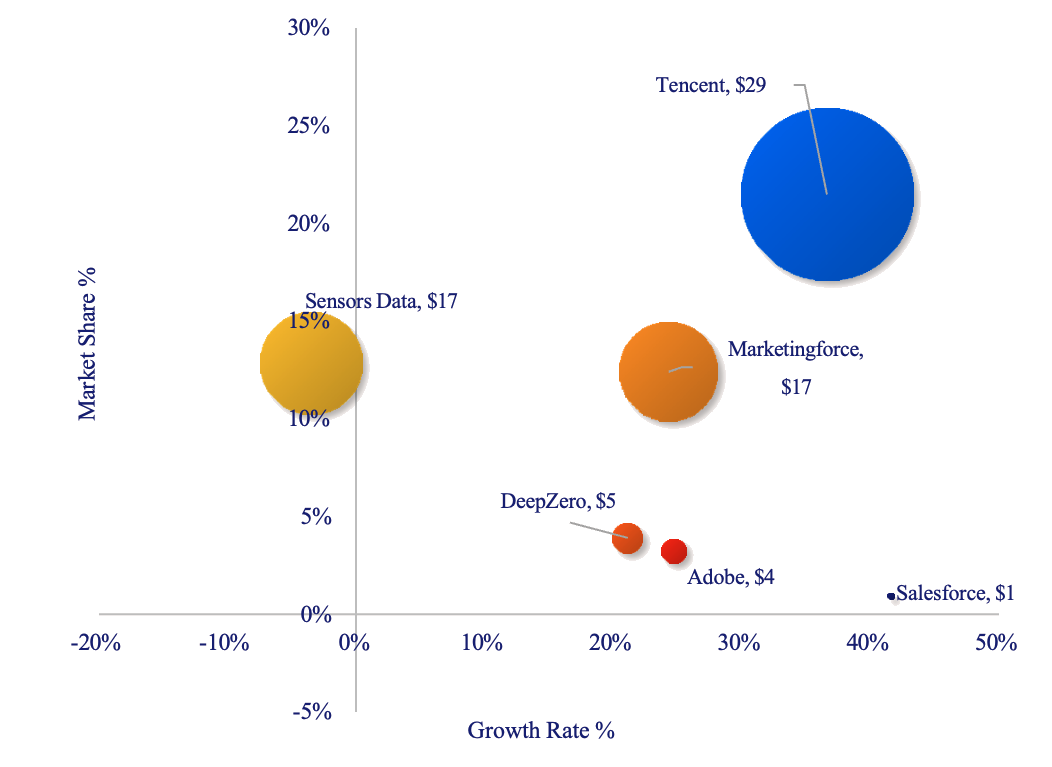
Looking at the H2 2025 competitive landscape, Tencent is in a clearly leading position in China's CDP market, with a market share of approximately 21.5% and year-over-year growth of 36.7%, showing its competitive edge in both market scale and growth momentum.
Tencent Marketing Cloud's competitive edge does not merely come from single-point CDP product capabilities, but from the WeChat ecosystem, WeCom, advertising resources, public-private domain data connection capabilities, and its product matrix. Relying on the synergy of ecosystem entry points, data touchpoints, and marketing scenarios, Tencent is forming platform-level competitive moats and continuously enhancing its market influence among large-scale enterprise customers and private domain operations scenarios.
Five-Year Development Trends for China’s CDP Market
IDC predicts that by 2030, China's CDP market size will reach USD 541 million, with a compound annual growth rate of 18.7%. The market will expand steadily, with cloud deployment and AI-native capabilities serving as its core drivers. Drawing on data and technology trends, the development of China's CDP market over the next five years can be summarized in the following four points:
- Continued rapid growth and market expansion: The CDP market will maintain robust growth momentum across 2026–2030, with the overall market size nearly doubling and annual growth rate maintained between 16% and 21%. Enterprise demand for customer data governance, intelligent marketing, customer lifecycle management, and private domain operations continues to rise, driving the market's transition from early construction-led growth to business-value-driven growth, featuring parallel progress in market size expansion and tangible value realization.
- AI-native capabilities as the core of market differentiation: AI technology is deeply integrated into CDP, driving the evolution from a traditional customer data platform to an "AI-native CDP". Enterprises not only use CDP for data integration and analysis, but also rely on AI agents for audience segmentation, customer tiering, content generation, and automated marketing decision-making. AI-native capabilities enhance the product's end-to-end business workflows, serving as a key variable driving the accelerated market growth in H2 2025 and rapid adoption by new customers.
- Cloud deployments as a driver for incremental growth, leveraging distinct SaaS mode advantages: Public cloud SaaS deployment is growing rapidly, expected to account for over 50% of the overall market by 2030. SaaS deployment enables rapid time-to-market, low initial investment, flexible access to AI modules, and continuous iteration, effectively addressing diverse scenario needs of mid-to-large enterprises. Compared with traditional on-premises deployments, cloud-based CDP enables scalable delivery and accelerated rollout, serving as the primary driver of future incremental growth.
- Industry-specific and intelligent scenarios reshaping the competitive landscape: Future competition is no longer just a comparison of data platform capabilities, but a comprehensive competition of AI capabilities, deployment flexibility, and implementation of industry-specific solutions. Industries such as retail, e-commerce, finance, automotive, and consumer goods will contribute significant increments. Vendors develop differentiated solutions by combining AI-native CDP with SaaS, industry-specific models, and intelligent marketing agents. This seamlessly bridges the gap from customer data to business growth, improving market share and customer stickiness.
IDC Recommendations for Technology Vendors
Source: IDC’s PRC Semiannual CDP Tracker, 2025H2