On March 27, at the Tencent Cloud Shanghai City Summit's AI Marketing and Transactions session, Tencent Marketing Cloud delivered a major upgrade: It launched Tencent Marketing Cloud MAGIC Agent 2.0, which not only automates intelligent user segmentation and proactively identifies marketing opportunities, but also takes the lead in introducing the marketing skill framework to make marketing more intelligent and flexible.
The edition of Tencent Marketing Cloud outside the Chinese mainland was released simultaneously, deeply adapted to social ecosystems, transaction habits, and unique business scenarios in overseas markets to help Chinese enterprises expanding abroad integrate into local markets more quickly
Brands such as Laoxiangji, Yonglian Industrial (Group) Co., Ltd., and Haoxianglai also shared their co-creation results with Tencent Marketing Cloud at the event
1
MAGIC Agent fully upgraded to 2.0
More proactive, flexible, business-aware, and convenient
AI marketing faces challenges when being deployed in the enterprise environment: first, a lack of true understanding of marketing "people-goods-venue" data; second, a lack of systematic, out-of-the-box tools that connect directly to real enterprise marketing scenarios; third, an inability to meet enterprise-grade security requirements.
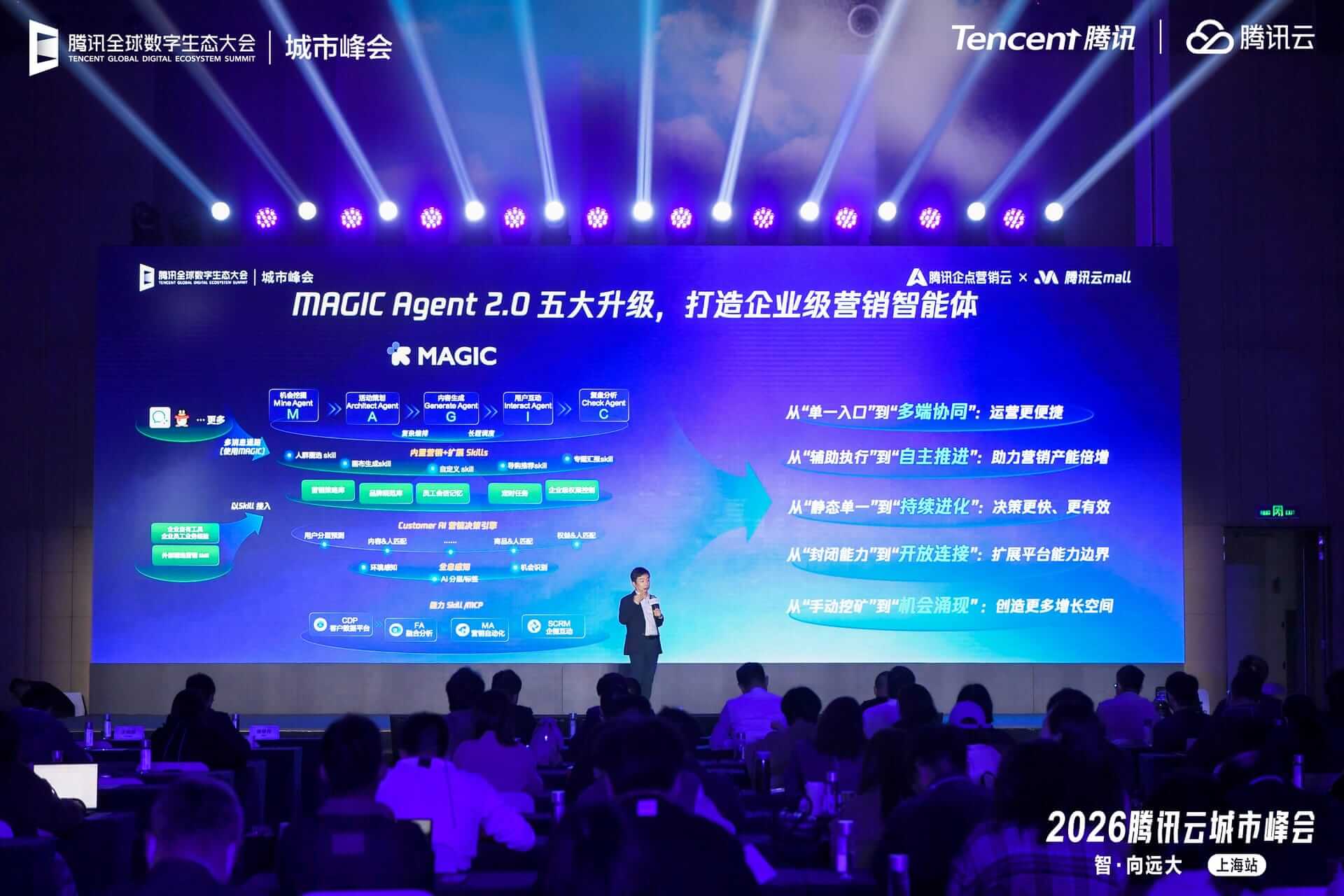
Li Xuechao, vice president of Tencent Cloud and Tencent's marketing and transaction product owner, introduced that MAGIC Agent 2.0 integrated personal intelligent agent technology based on the original agent to deliver intelligent upgrades of capabilities in multiple key scenarios
1. More proactive It enhances the deep perception and insights into vast people-goods-venue data.
Unlike traditional "manual monitoring" for growth opportunities, MAGIC Agent 2.0 can proactively achieve intelligent user segmentation and clustering, and proactively identify problems and marketing opportunities.
2. More flexible It leads the introduction of the marketing skill framework.
On the one hand, it provides rich built-in marketing skills for true out-of-the-box use; on the other hand, enterprises can package their own tools and marketing practices as skills to integrate with the platform, and can also install selected ecosystem skills with one click to expand their marketing capability boundaries.
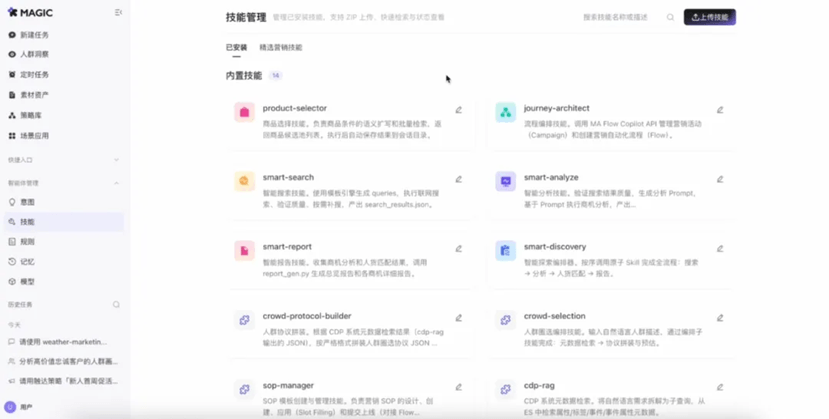
3. More business-aware It can identify and manage individual preference memories and the enterprise's strategy library.
It enables the marketing system to become progressively more business-aware and easier to use over time, while effectively addressing the traditional marketing problem of loss of experiential knowledge.
4. More convenient It supports Claw and integration through multiple message channels.
Through the entries such as WeCom and other IM software, the marketing agent can be controlled across terminals and remotely.
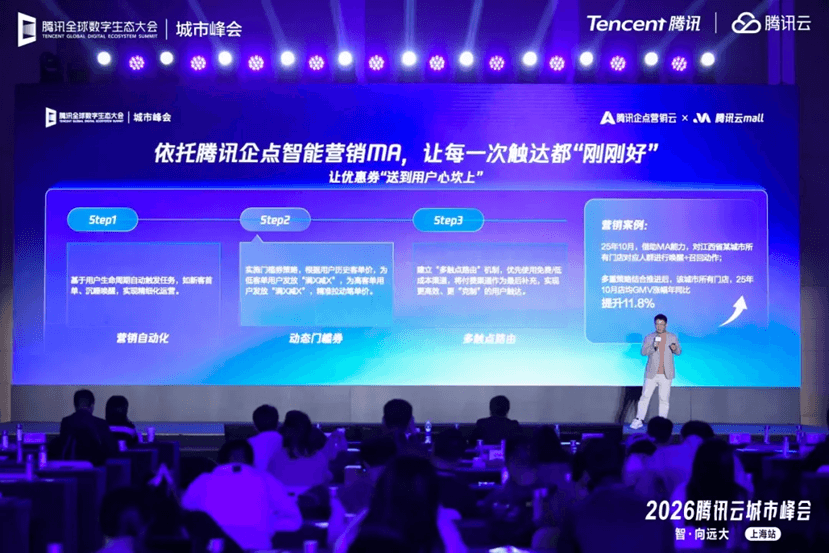
In addition, Tencent is integrating Tencent Marketing Cloud with the foundation of Tencent Cloud Mall. The "marketing brain" Tencent Marketing Cloud handles omni-channel data cleaning, high-value lead identification, and automated coupon issuance, while the "operational front" Tencent Cloud Mall manages transaction conversion, verification and fulfillment, and data backflow. The connection between the two enables more precise and diversified marketing approaches.
2
Tencent Marketing Cloud edition outside the Chinese mainland officially released
— empowering enterprises' global marketing
Zeng Wei, the product owner of Tencent Marketing Cloud, said that many enterprises often face challenges such as high customer acquisition costs, local operations that are difficult to adapt, and persistent data compliance risks after expanding abroad. As enterprises accelerate their global expansion, they need an intelligent engine that understands Chinese speed while being well-versed in local rules to help them integrate into local markets faster, deeper, and more securely
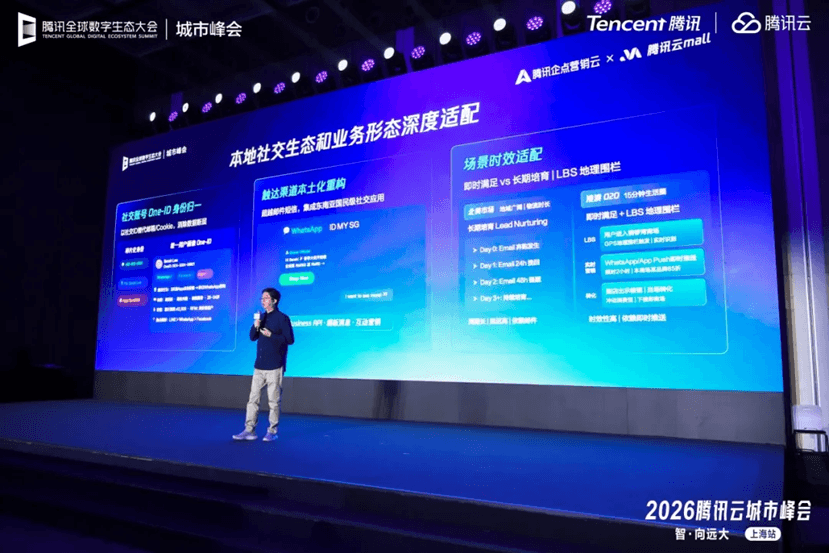
To address challenges such as local adaptation for enterprises' global marketing, this edition provides three core capabilities:
1. Deep adaptation to the local social ecosystem
It not only achieves a unified profile via the social account OneID so that the system can recognize the right person, but also natively integrates national-level social communication applications across Southeast Asia, Hong Kong (China), and Macao (China). For example, when users receive a promotional push in WhatsApp, they can browse smoothly and seamlessly without leaving the chat window. By combining scenario timeliness with LBS-based spatial adaptation, it can more tightly connect local online and offline commercial ecosystems.
2. Support for flexible skill import
Based on the LLM architecture, it supports rapid import and iteration of marketing skills to enable agile AI capability evolution.
3. Security that balances compliance and costs
It supports localized regional deployment to ensure that data does not cross the border
3
Customers from various industries share co-created cases of refined operations
Supported by increasingly mature AI infrastructure, intelligent marketing tools are reshaping marketing logic and mode, shifting from broad marketing through "flooding messages" toward personalized marketing characterized by "hyper-personalization".
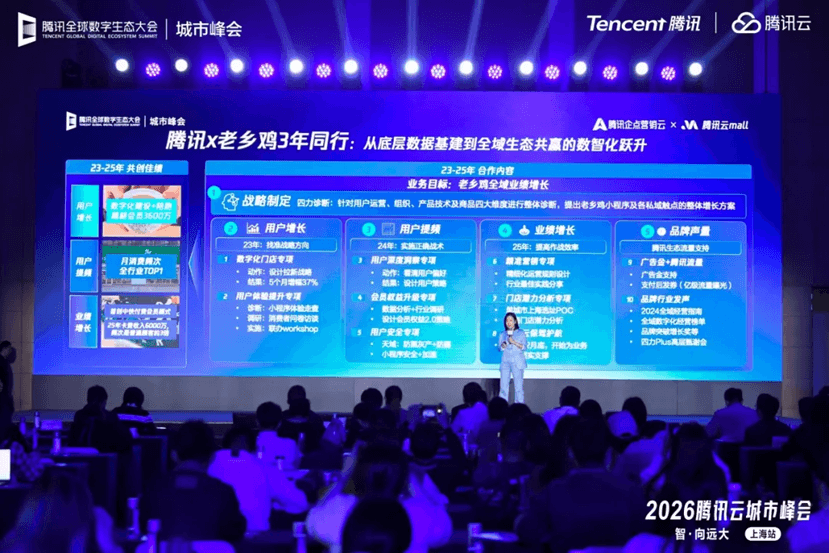
Su Xi, Laoxiangji's vice general manager, introduced in a session speech that the company "painlessly" migrated its CDP system to Tencent Marketing Cloud, building more than 100 CDP dashboards for member operation, dish marketing, private domain marketing, and special events. This made data of over 30 million members visible and analyzable, enabling in-depth exploration of user demands and the delivery of highly personalized reach marketing. Whether for new product launches, new store openings, or holiday campaigns, the system could automatically match the optimal strategy. Since Tencent Marketing Cloud system was launched in July 2025, Laoxiangji's precisely targeted reach has made its actual monthly GMV increase by about 10 times, becoming a major growth channel for revenue from member repeat purchases.
Qu Zhentao, CIO of Yonglian Industrial (Group) Co., Ltd., said that Yonglian has worked deeply with Tencent Cloud to build an omni-channel data middle platform, integrating scenic area ticket data, check-in data, consumption data, online interaction data, and offline behavior data into a unified "four-in-one" member architecture. By precisely clustering members, analyzing their data, and establishing a differentiated benefit system, Yonglian delivers hyper-personalization services. Coupled with a full-cycle operation closed loop of "public domain user acquisition - private-domain retention - ecosystem conversion - data feedback", the company continuously increases member stickiness and efficiently activates private-domain user assets of millions of users, making members "willing to stay, proactively spend, and continuously repurchase".
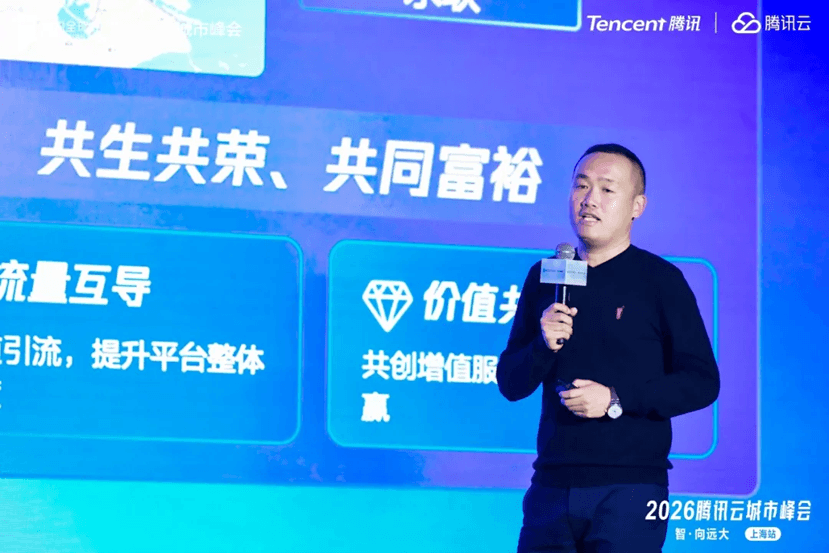
Jiang Ming, head of Haoxianglai's member operation center, explained that the company introduced Tencent Marketing Cloud's CDP and used OneID to integrate data from offline store POS systems, mini programs, historical orders, and WeCom groups, transforming "fragmented" user profiles into "panoramic views". This has made the data of 190 million members become identifiable, traceable, and operable assets, enabling automated, dynamic, and multi-touchpoint marketing for Members' Day, holidays, and other activities. Currently, the number of Haoxianglai's annual transacting members exceeds 140 million, with significant results from refined operations.
At the event, Xu Yingdan, vice president of Tencent Cloud and Smart Industries Group (CSIG), announced the launch of the "Magic Growth Master Starlight Program", a public call to nominate, recognize, and commend the front-line personnel related to operation growth who "effectively use Tencent Marketing Cloud AI tools, understand user demands, and drive engagement". The program aims to surface the behind-the-scenes stories of enterprises applying intelligent marketing and to provide sustainable, replicable methodologies for various industries adopting AI.
Chen Fei, senior vice president of Tencent Cloud, noted that full agentization is the inevitable direction of application evolution. The key to improving efficiency lies in integrating permissions, data, and features within a security framework to enable autonomous decision-making and cross-scenario execution. Currently, the barriers of a single model are gradually fading. Future competitiveness will depend on collaboration, connectivity, and closed loops. To this end, Tencent is integrating marketing cloud and transaction product capabilities to enable strategic collaboration under the agentization trend, while linking with Tencent Ads' public domain capabilities for mutual empowerment. With AI agents as the underlying logic, Tencent aims to create a natural closed loop of public domain, operation, marketing, and transactions, offering integrated intelligent operation solutions for omni-channel operation.