Today, with the rapid evolution of AI technology, how can enterprises break away from the traditional path of "making decisions based on experience" in marketing and truly achieve growth driven by intelligence?
At Tencent's 2025 AI Industry Application Summit on May 21, Li Xuechao, Vice President of Tencent Cloud and head of Tencent Marketing Cloud, delivered a speech on the theme "From experience-driven to agent-driven, AI powers end-to-end marketing transformation". At the summit, Tencent Marketing Cloud Agent was officially released, demonstrating how AI technology, as the core, can reshape the three core capabilities of marketing, that is, perception, decision-making, and execution, and usher in an era of "AI+Marketing 2.0".
From making decisions based on experience to making precise decisions, what challenges do enterprises face in marketing?
Despite years of development in marketing technology, from marketing platforms to AIGC tools, many enterprises still ask: Why did my budget not produce the expected results?
In the past, even when many enterprises used classic marketing platforms, they still faced three challenges:
- Experience-based audience selection: Rules are set based on experience, data is used roughly, and targets are vague, leading to difficult implementation of user segmentation.
- Same content for all: Benefit resources are uniformly allocated, homogeneous content is output, and user-reaching methods are monotonous, causing a weak user experience.
- Formalistic review: Without high-quality analysis and strategic insights, experience loops cannot be closed, leaving future campaigns driven by guesswork.
This also means that traditional platforms focus on process automation rather than true strategy intelligence.
Later, with the rise of big data and AI technology, many entrepreneurs and marketers began to explore the value of data, creating the "AI+Marketing 1.0" form:
- More refined audience: The audience selection logic is optimized based on behavioral tags.
- More personalized content: AI tools are used to generate different content for different audiences.
- More agile review: Analysis models are used to improve strategy evaluation efficiency.
However, a problem is that these capabilities often operate in silos. The marketing chain is long, and links are mutually restrained. From audience strategy, benefit design, and product and content strategies to feedback review, there is a lack of coordination and unified cognition among marketing roles, making it difficult to achieve end-to-end marketing effectiveness.
Therefore, Tencent Marketing Cloud gives a new answer to "AI+Marketing 2.0": a new marketing upgrade driven by agents.
Tencent Marketing Cloud Agent reconstructs the end-to-end marketing chain
To address the challenges of a long marketing chain, multiple roles, and complex strategies, Tencent introduced a new-generation product form, that is, Tencent Marketing Cloud Agent.
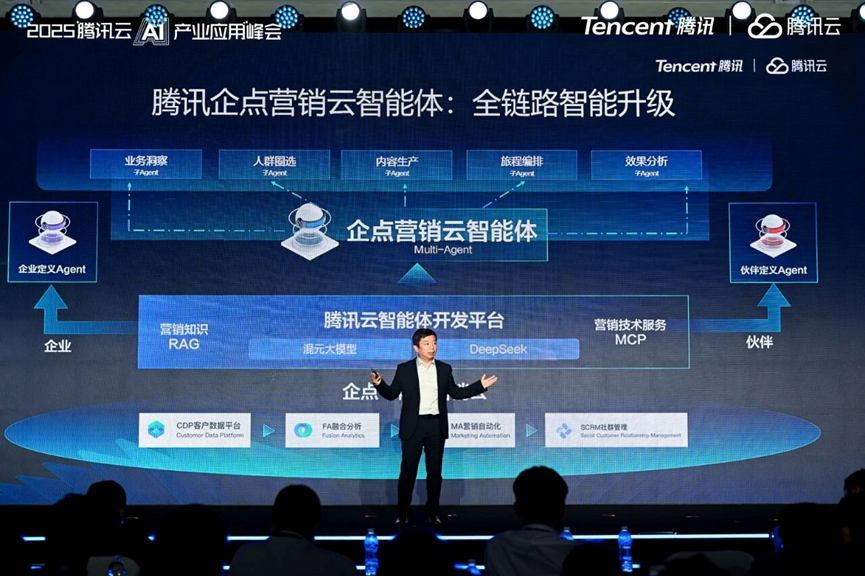
Built natively on Tencent Cloud Agent Development Platform, Tencent Marketing Cloud adopts a Multi-Agent architecture to modularly disassemble agents, collaboratively realizing the intelligent end-to-end marketing transformation, covering perception, insight, and action:
- Hunyuan LLM + DeepSeek model as two engines: provide powerful inference and generation capabilities.
- Marketing knowledge RAG technology + marketing service MCP technology: deeply integrate business data, technology, and marketing strategies to build exclusive agent systems for enterprises.
- End-to-end sub-agent collaboration: covers multiple intelligent roles such as business insight, audience selection, content production, journey orchestration, and effect analysis.
Five core stages enabling seamless end-to-end integration
1. Target breakdown + precise audience selection
Starting from business goals, the agent takes into account both short-term conversion and long-term value, and with AI prediction models, quickly identifies audiences as repeat purchasers or churned users for more accurate recommendations.
2. Automatic matching of content and benefits
According to different user features and product features, the agent automatically matches benefits and strategies, intelligently generates content matrices that cater to the preferences of different audiences, improving the ROI of marketing conversion.
3. Intelligent journey orchestration and reach
Based on the user lifecycle and conversion probability, the agent can automatically complete multi-round, audience-based, and cross-channel reach path orchestration, greatly reducing manual configuration costs and complexity.
4. Automated execution and closed-loop management
The agent automatically executes marketing plans, covers multiple touchpoints such as SMS, WeCom, and communities, accurately controls delivery timing, and realizes the integration of intelligent thinking and automated action.
5. Effect attribution + strategy accumulation
For elements of a campaign, such as audience, benefits, content, and journey, the agent can evaluate the effect of the campaign at the individual user level, output a review report, and generate reusable knowledge.
The "super partner" for future marketing is already in place
From today onwards, we can all have an intelligent partner who understands data, business, and strategies. It will continuously learn and iterate, drive marketing decisions with knowledge, data, and AI, and help enterprises spend every penny where growth is most likely to occur.
"Tencent Marketing Cloud Agent makes intelligence endless and helps enterprises grow."